Networks and high-dimensional inference
Block lecture (3 SWS)
Course description
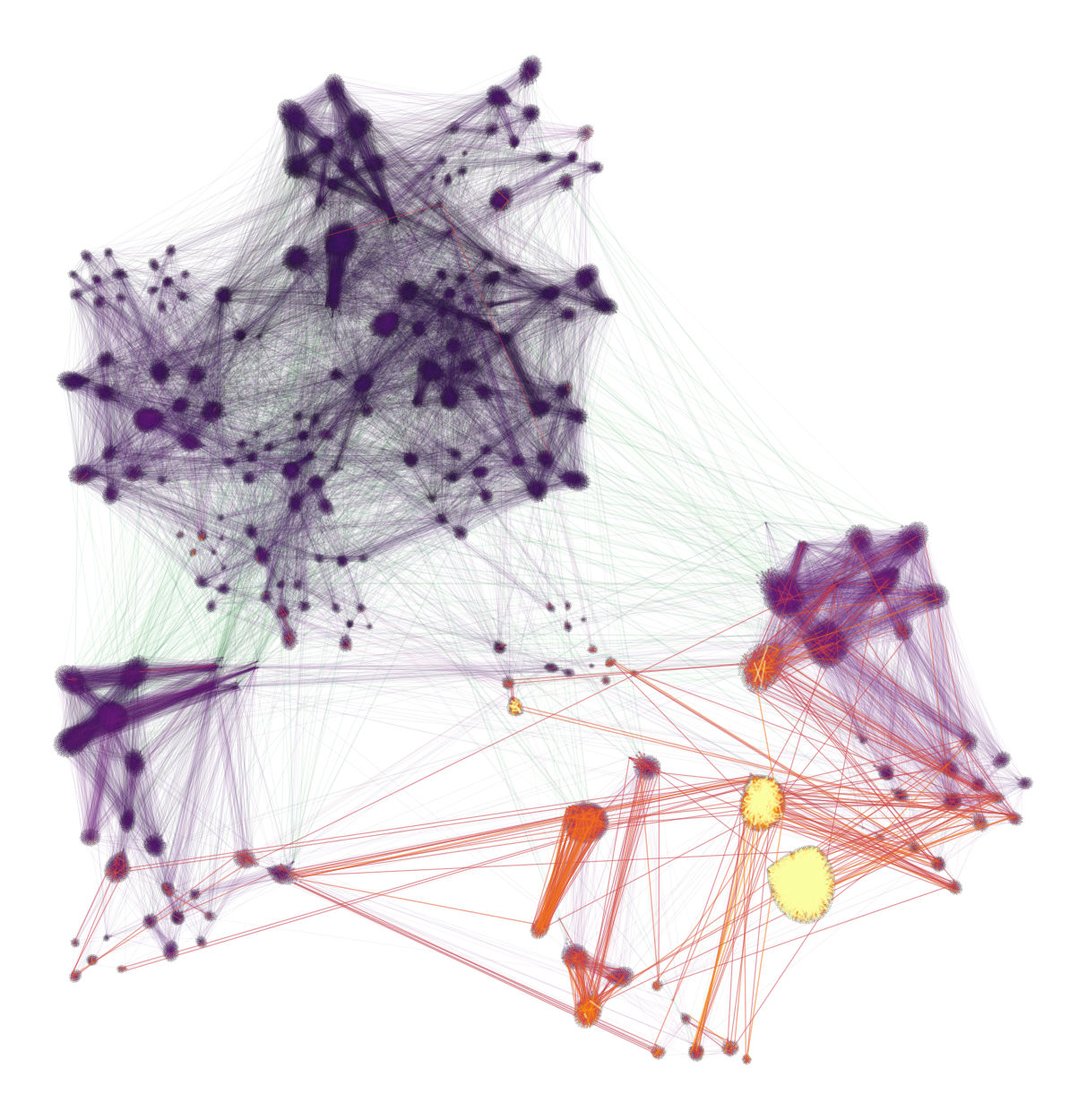
The internet, social platforms, ecosystems, biological cells, financial markets, and neural circuits are all examples of systems whose behavior emerges from large networks of interacting elements. Understanding the structure and function of such systems is essential for addressing key scientific questions, including:
- How does a pathogen propagate through a contact network, and where should interventions be targeted?
- Which genes interact to cause disease, and how do mutations alter these interactions?
- How does information—or misinformation—spread through a social network?
- What is the architecture of influence in financial systems, and where do systemic risks arise?
- How does the brain’s connectome give rise to cognition?
In practice, however, real-world networks are rarely observed cleanly—or even directly. Edges may be missing, noisy, or temporally aggregated; node attributes and dynamical rules are often unknown. Even under ideal measurement conditions, network structure is difficult to interpret due to its high dimensionality and the presence of latent structures that must be inferred.
In more challenging settings, the network cannot be observed at all and must instead be reconstructed from indirect data, such as snapshots of its resulting behavior: E.g. species abundances in ecosystems, disease co-morbidity patterns, or fMRI brain activity.
Bridging network models with data therefore requires solving an inverse problem: given observations of a system’s behavior, how can we infer the hidden mechanisms that generate it?
This course explores contemporary topics at the intersection of statistics, computer science, applied mathematics, and physics, focusing on theory and methods for inverse problems in complex, high-dimensional, relational systems.
Students will study mathematical models of networks and investigate how simple interaction rules give rise to emergent behavior. They will also learn principled computational methods for inverting these models—recovering interaction rules from observed data.
By the end of the course, students will be able to infer latent structure from network data, identify missing or corrupted information, and reconstruct interaction networks from time series or behavioral snapshots. They will also develop a conceptual, mathematical, and algorithmic understanding of core challenges in high-dimensional inference—such as non-uniqueness, ill-posedness, and underdetermination—and learn to address them using robust frameworks grounded in information theory and Bayesian statistics.
Target audience
This course is intended to MSc students in computer science and mathematics, with students from physics also being welcome to attend.
Basic knowledge of (and enthusiasm for) statistics, probability, and programming is expected. No previous advanced knowledge of statistical inference is required.
Parameters
This course will be taught as a block course, outside the regular teaching period, from 20.07.2026 to 31.07.2026, with daily lectures Mon-Fri from 9:00 to 12:15.
Time: Mon-Fri, from 9:00 to 12:15.
Location: Robert-Mayer-Str. 11-15, SR 11
Language: English
Evaluation: Final oral exam
Registration via OLAT 👈 Please register if you are interested in attending!
Course catalogue entry: QIS link
Schedule
- Lecture 1: Graph theory and networks in the real world
- Lecture 2: Generative network models
- Lecture 3: Network function and dynamics
- Lecture 4: Bayesian inference, model selection and averaging
- Lecture 5: The minimum description length principle
- Lecture 6: Inferential community detection
- Lecture 7: Network completion and link prediction
- Lecture 8: Network reconstruction from dynamics
- Lecture 9: Latent spaces and rankings
- Lecture 10: Open problems and future directions
Literature
Resources
- graph-tool: Efficient network analysis with Python.
- Netzschleuder: Network catalogue, repository and centrifuge